Only on X, don’t trust fake accs
AI/Semi Supply Chains
NFA DYOR, no paid promos; may trade/hold names disc, views my own. Sharing free AI chokepoint research
Dumb Signal has archived 1,881 posts
from Serenity (@aleabitoreddit) and classified
171 as real trade calls — each priced the day it was
made and graded by direction-signed returns at 1D / 1W / 1M / 1Y, deletion-proof.
Every AI name in Taiwan from Mediatek to Winbond looks like its limit up.
TAIEX: +4.94%, its 2nd largest daily gain in history.
I guess the market is impressed by $NVDA’s Jensen Huang vitality at his age?
$NVDA$2454.TW$2344.TW$2308.TW$3006.TW$TAIEX
I fully support $NVDA and Jensen Huang through this time.
Even the most legendary figure in the AI industry is human.
Trump, Clinton, Bezos, Gates, and many others have faced scrutiny over their personal lives.
It takes courage to own up to it publicly and move forward
$NVDA
Various commentary from Qualcomm, Arm, to Meta executives this week during the AI selloff:
$LITE CEO: "You had a comment from the CEO of $IREN and I'd second that. There's a massive disconnect in what we're seeing in our demand books.
And what the markets are showing. And yet you're seeing a massive, massive selloff." (Fri, Nov 6)
$AMD CEO CNBC: "We're at the very beginning of the adoption cycle, where people can see where AI and superintelligence will take us"
"We are seeing demand being higher than supply" (Wed, Nov 4)
$ARM CEO regarding a debate whether AI infrastructure spending is about to peak:
"I think in some states where it gets harder, other states may pick it up to make it easier, but I do believe strongly that if the US hesitates in any way shape performance in terms of data center buildout...
"The rest of the world is ready and willing. There is just huge demand for this capacity. And I think globally the US really wants to be able to compete against China. China is not slowing down at all." (Thu, Nov 5)
$APLD CEO: Bank construction lending, project financing and bond markets remain available, although interest rates and credit spreads have risen
"The big risk is delivering on time." "The demand picture is extremely robust." (Mon, Nov 2)
$QCOM CEO: "It's not demand bound. It's a supply bound."
"We're short on wafers, we're short on substrate, we're short on assembly. Everything is short because demand is very, very high."
"I think what the market is reacting to is what is the speed of the compute build out."
$META on political risk: "We did have a governor that won last night who did make data centers a big part of the platform.
Say as soon as we get past the inauguration, let's meet because we don't want to lose this investment in our town. We don't want these jobs to go elsewhere." (Wed, Nov 4)
Even politicians campaigning against data centers are negotiating. But Meta's president also emphasized that starting new US DCs will become more difficult.
TLDR:
-> Extremely bullish commentary from accelerator players, networking, and semi companies
-> DC developers report strong pricing/demand, but increasingly emphasize financing, permitting and execution risks (more cautious)
-> Politicians that previously campaigned against DCs are showing cooperation
There's an important difference between demand disappearing and demand being delayed by the inability to build fast enough.
Despite the severity of the selloff, I'm not seeing evidence of widespread AI demand destruction in commentary.
$LITE$IREN$AMD$ARM$APLD$QCOM$META
It think it's stupid that "AI Bubble" gets used over and over. In infra names you have:
- 1-3x fwd P/E memory companies from Samsung to $ESMT. With HBM players now having hyperscaler multi-year price floor LTAs.
- Optical companies like $POET traded -$97M under net cash. Valuing the operating business very negatively, not even at $0.
- While AI companies with larger premiums continue to record demand over the next 3-5 years. Such as the new $20B LTAs signed w/ $COHR to $5B LTAs signed w/ $LITE.
Can someone in the media honestly see negative EV high-beta optical companies, where 2 years of burnrate would still value the company below $0.
or single digit memory companies with contracted demand + price floors years out and say that's a bubble?
Many of these names are extremely profitable today...
But obviously there's other elements inside the theme, such as:
- Certain startups like Instinct that look like a private valuation bubble.
- Leveraged Neoclouds that didn't finance properly
- and AI lab valuations and commitments, which should be viewed cautiously.
But everything gets grouped into one with the boogyman of "leverage" or "debt".
Yes, valuations can compress or correct from macro, potential regulatory uncertainty, or potential capex reductions.
But for the companies physically powering the AI buildout, it looks more like the Great AI Deleveraging of 2026...
Than anything like fundamental demand destruction.
As more earnings come out and free cash flow accumulates over time.
I'm confident in a recovery, especially in bottlenecks, and for markets to eventually discern durability + growth over frothy valuations tied to AI.
$ESMT$POET$COHR$LITE
The two things I'm excited about are Gen G vs. T1...
and new NASA's $10 Billion contract to begin settling on the moon. NASA selected:
- $SPCX (SpaceX)
- Blue Origin
- $FLY (Firefly)
- $LUNR (Lunar)
- $LMT (Lockheed Martin Space)
- $NOC (Northrop Grumman Space)
- $VOYG (Voyager)
- iSpace US
to compete for future lunar delivery missions
- $1.3B in launch and orbital transportation orders awarded to Arrow Science, Blue Origin, and Impulse Space.
- $94 million for Blue Origin to deliver NASA's nuclear powered PROMISE rover
- Existing CLPS 1 contract ceiling raised from $2.6B to $4.2B.
- NASA also announced awards to Honeybee Robotics, a Blue Origin company, $RDW for a lunar power and communications tower
$SPCX$FLY$LUNR$LMT$NOC$VOYG$RDW
Yep! That's a fair example with onsemi. But I'm not quite sure it's appropriate to extrapolate from historical examples of mutually agreed contract changes.
And apply that to today's memory market and assume $MU would make concessions if demand/pricing ever drops.
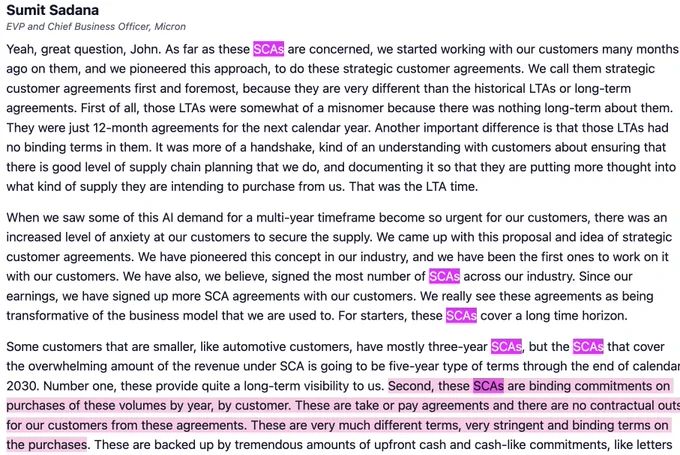
Micron really went out of their way to emphasize that their SCAs are different relative to historical ones in terms of contractual price floors + binding commitment clauses.
$MU$ON
If someone asked me 10 years ago what I'd be doing in the future,
Answering questions on Jensen + Spys banging each other and implications on the AI trade would not be in mind
My response to that question is: how am i supposed to know?
On AI trade implications: $NVDA probably wanted to sell more chips anyway (to China) for revenue and it's extremely unlikely this person had any effect on trade policies.
The relationship might not even be true... anyway I'll wait until more news comes out.
$NVDA
A $TSM Spokesperson has reportedly denied exploring 3D DRAM per Tom's Hardware.
After a report yesterday from The Information stated TSMC's production plans were from $NVDA's request.
The implications would have put TSMC in competition with $MU, SK Hynix, and Samsung and set off narratives about TSm disrupting the biggest memory makers.
There's something frustrating with there's market moving headlines both ways. It just creates more confusion and volatility...
Especially if something (like $NVDA CEO honeypot allegations) or the TSM report yesterday turns out untrue.
$TSM$NVDA$MU
$MSFT an old 2023 contract to support AI-powered Bing ended, and Microsoft declined to renew.
Older generation GPUs did not fit this specific customers use case, that doesn't mean they "dunked on Oracle".
If this happened to new B300 contracts that would be worrysome, but the recent media headlines are extremely misleading.
$MSFT$ORCL
So two things:
1. I'm now fundamentally positive on $IREN post Mirantis acquisition and after their recent earnings. Their operating outlook and ability to finance has looked more compelling.
2. That doesn't always translate to appreciating share price and ROI to shareholders.
I have caution regarding their existing $6B ATM, which now has $2.37B left (so they have been going through it).
As well as CEO executive compensation, which I'd argue would be more beneficial if this were done through appreciating share prices rather than dilution.
Obviously optics on their NBA Warriors deals are very bad while they're unprofitable... but I'd treat this as noise relative to the scale of the ATM overhang + executive comp.
So a lot of weighing different float + market dynamics vs. operational business, but I'd argue this is something that still can be addressed.
$IREN
Even with current narratives like biotech eg. $TWST, there's 100%+ Y/Y growth from their AI testing segment with Anthropic.
But if you look at company overall revenue projections, they're only calling for double revenue growth by 2031 (implying 15% annual growth).
I'm sure they can beat, but this seems relatively slow compared to AI supply chains growing hundreds to 1000% Y/Y and seeing record levels of net income growth Q/Q.
Not all bottlenecks have the same economic impact the way hyperscaler capex in AI supply chains does.
$TWST
I'm going to give a contrarian take on Neoclouds like $NBIS and say the theme looks compelling after the valuation crash.
Since there's a reason why Elon's $SPCX is heavily focused on this market full of "guppies" that would die:
He sees how attractive the economics are after selling compute to $GOOGL and Anthropic.
And this is reflected by his actions not words, from SpaceX's recent $40B financing for GPUs procurement.
$AMZN, $MSFT, and even $META also see how profitable the economics are and are accelerating their AI DC buildouts.
I'd argue if a Neocloud has:
- Close relationships with $NVDA + others for allocations
- Existing contracted capacity + permitting
- Well funded counterparties, such as Hyperscalers.
- Attractive economics, such as financing their procurement correctly (not the way $CRWV has with high debt interest unless they refinance).
Then I think they'll do just fine...
However, the bigger worry is more toward newer players starting financing or the permitting process, since barrier to entry has now become extremely high.
For financing, read through on $IREN earnings has shown public Neoclouds can adapt extremely well to tight markets:
As seen with their 90% prepayments for GPU capex on a 5Y deal.
Their older H100 GPUs recontracted at double their previous pricing and 12% higher contracted pricing also point against depreciation fears.
And in the case DC buildouts slow from permitting delays... it heavily favors some over others.
Rosenblatt's recent note for example stated they see little risk with $NBIS primary buildout that was in Missouri, Pennsylvania, and South Carolina.
And there's probably less risk with developers in places like Australia.
Markets have also show this infinite compute arbitrage can't go on forever, hence the reluctance to further finance capex, via things like ATMs.
But ironically, tighter financing and hypothetical restrictive permitting would increase the competitive advantage of established neoclouds.
And create a larger moat against newer DC developers.
$NBIS$SPCX$GOOGL$AMZN$MSFT$META$NVDA$CRWV$IREN
Higher power lasers for CPO/NPO generate much higher pricing premiums and associated gross margins
compared to lower range CW lasers (that's still in a bottleneck).
There's also a premium since less players can actually supply CPO lasers, so the company is more strategically valuable.
But what matters in the end is net income.
I'm sure the Sivers CEO has more visibility, so if they can supply pluggable lasers at scale to bridge the gap between 2028 CPO opportunities, that's an alternative.
$SIVE
@semivision_tw 市場暴跌後,我現在還勉強活著。
我從來沒想過 $LITE 被 $MRVL 收購後,股價竟然還能暴跌 -51.53%。
結果沒想到,連收購方 $MRVL 也一起崩了 -50.3%。
$LITE$MRVL
I still own shares in the million range, which is a material % of the overall company for $SIVE.
I've been extremely critical of their recent communication and disclosures around CPO, which is why I originally invested.
But given their focus on pluggables, if they disclose more qualifications like $CRDO or Innolight, I'd gladly increase concentration.
I'm personally waiting for earnings in 19d to evaluate the company.
$SIVE$CRDO
| return | 1D | 1W | 1M | 1Y | now |
|---|
| $CRDOlong |
+10.3% | +9.1% | — | — | -4.1% |
| $SIVElong |
| | | | |
From this year's peak, Asian indexes like:
Indonesia are down −44.7%
Korea's KOSPI is −44.5%
Japan's Nikkei is −20.6%
Taiwan down −20.3%
China down −14.3%
Equity markets in general have been experiencing a heavy drawdown, and I don't think it's a specific problem with individual optical names in China.
I've seen Innolight and others report strong earnings, but feels like everything is getting sold off.
Can't give advice unfortunately, but in my perspective optical industry should outperform long term, even if it looks like everything is dropping.
But no clue if how they perform in the short term.
$300308$KOSPI$NIKKEI
My cost averages are a lot different. My memory longs were once up +450%, but many are probably down to +50-100% unrealized. I still hold those.
Just tax lost harvesting a bit of my $AAOI position over time was a few million realized losses (I'm still long, this is just tax related stuff each month)
Can say the same for a lot of other names.
There's a lot of volatility and risk management in between, but I think they'll perform well in 2027.
$AAOI
| return | 1D | 1W | 1M | 1Y | now |
|---|
| $AAOIshort |
-3.9% | +0.5% | — | — | +18.4% |
I think we've reached extreme market dislocation territory.
$POET as one example traded close to -$98M under their net cash on Thursday, giving a very negative value to their actual business.
But even if hyperscaler capex gets reduced, I'd argue demand visibility on some bottlenecks from substrates, memory, and optics far exceeds market current valuations.
And the sector drop presents a very compelling opportunity.
$POET
I know this is an AI reply but just to piggyback, I agree counterparty analysis is really important.
If we look at memory LTAs, in general they're primarily coming from $NVDA, $GOOGL, $AMZN, and your richest hyperscalers.
Other commitments come from Qualcomm to Hyundai.
Companies like Microsoft aren't distressed solar companies or manufacturers that defaulted back in the 2010s.
$NVDA$GOOGL$AMZN$QCOM$MSFT
Some industry commentary regarding a few claims recently on memory + Softbank Turbine defaulting.
- On claims that LTAs are "meaningless while prices fall":
$MU: "strategic customer agreements cannot be unilaterally canceled. Customers are obligated to pay for their committed volumes whether they take delivery or not"
"These are take or pay agreements and there are no contractual outs for our customers from these agreements"
Regarding historical contracts breaking: "These LTAs that we used to have never had any binding terms." The new SCAs contain extensive contractual obligations
Regarding Elon's claims on Softbank defaulting on Turbines:
Question from Morgan Stanley to $GE Vernova CEO on whether they see cancellations or financing difficulties with counterparties on their turbine orders:
“No… we are not”
TLDR:
- Micron states LTAs/SCAs are noncancellable take/pay (where counterparties are hyperscalers). And that these types are different from historical memory cancellations.
- On Softbank turbine orders, GE Vernova CEO Scott Strazik said it wasn't seeing customer financing disruptions, requests to exit turbine reservations, or slowdowns.
Maybe Elon's claims are more narrow, but should be evaluated more closely given competitive interests vs. Softbank/OpenAI.
$MU$GE
It’s sad to see X and media turn so extremely negative
That there’s now arguments made for “Take or Pay” noncancellable memory LTAs being cancelled.
$MU: “strategic customer agreements cannot be unilaterally canceled.
Customers are obligated to pay for their committed volumes whether they take delivery or not.”
When talking about breaking LTAs from previous historical events: “These LTAs never had any binding terms.”
Then there’s TMZ style coverage on $NVDA CEO relationships
To misleading cancellations between $MSFT and $ORCL when they were from 2023…
Every single day now from the media.
Elon Musk posting something negative about Neoclouds to the Korean/Japanese memory companies doesn’t help either.
Even today there’s something about SoftBank defaulting:
$GE Vernova CEO on whether they see cancellations + financing difficulties on counterparties or turbine orders
“No… we are not”
Maybe there’s some non-public info not released yet? But I found find it strange that an OpenAI competitor would disclose this
I’m personally fine with the volatility, and it’s fine if people have bearish arguments.
But the level of misleading commentary or unsubstantiated accusations has hit a record level.
And when you see the damage this causes to individuals lives in Japan to Korea to Taiwan.
It’s very sad to see.
↗ Quoting @polarislog
$MU$NVDA$MSFT$ORCL$GEV$SFTBY
I found the technical discussion helpful, but investor messaging to be way too conservative.
If you look at how $NVDA CEO describes CPO, Jensen states scale up is increasing optical volumes by 15x. $LITE and $COHR are quantifying that by describing $5-$20B agreements spanning 3-5 years out.
Having this question, and not talking about Ayar, O-Net, Poet, or ELS partnerships. Then redirecting the question to near term pluggables seems off.
The vision also needs work, “communications and sensing” semi company is very unexciting.
It’s technically true, but there’s no vision being communicated on being the next $40B optical giant or what Sivers is going to be in the next 5 years that would attract long term holders.
The core valuation Sivers gets is from optical opportunities, I also personally disagree that it’s helpful to loop back to former cellular relationships when talking about future $GFS volumes
I disagree when you portray the company as “small” when Sivers 100m CW DFB capacity is coming online, alongside large foundry partners.
Which is a material % of the world’s annual laser capacity.
Investors want to hear about future economic opportunities and how you fill the gap with more qualifications during a bottleneck.
Sivers has a tremendous opportunity for CPO/NPO/Pluggables but I’m afraid it’s not being communicated properly.
It’s understandable here since EETimes is more technical oriented, but I hope this messaging gets communicated better in the next earnings call.
$SIVE$NVDA$LITE$COHR$GFS
Woah, this caught my attention today. Apparently $ASTS decided to build their own medium/heavy lift reusable rockets.
Could be a potential competitor to $RKLB Neutron or $SPCX Falcon 9?
"Starting in late 2028, the use of the Blacklift rocket will complete AST SpaceMobile's end-to-end vertical integration"
But it kinda seems extremely difficult, capital intensive, and takes very long to do... But more valuable if they can pull it off
Does anyone in the Spacemob think this is realistically achievable given AST capabilities?
$ASTS$RKLB$SPCX
In response to the recent market volatility across $TSM to $SKHY to Innolight:
- Taiwan to restrict borrowed share short selling from 30% -> 3% relative to order volumes (90% reduction), effective Nov 9th.
Taiwan is separately raising its minimum collateral requirement from 90% to 130% for margin short selling.
And authorized the $15.3B stabilization fund for Government buying in the stock market.
- South Korea to waive 140% margin-loan collateral maintenance for 3 months to reduce forced selling, effective Nov 9th.
- China introduced a series of stock-market support package aimed at stabilizing equities. People's Bank of China introduced a $15 billion liquidity-swap operation for securities firms and fund managers.
As well as reduced lending rates for the share buybacks and shareholder purchase programs from 1.25% -> 1% this month.
_
Not saying what direction stocks would go, but with Countries heavily tied to the AI trade introducing short selling restrictions, share repurchases, and reduced margin collateral.
These market mechanics are bullish for near term market stability + potential reversal in equities.
$TSM$SKHY
Everyone’s a long term investor for 2027, 2028, or 2029 onward
Until their portfolio experiences volatility months in. I still think:
- $RKLB could end up the next $SPCX
- $NBIS has the potential to be the next hyperscaler
- $SIVE has moonshot potential to be the next $LITE
- 1-3x P/E memory companies and $AXTI substrate bottlenecks are more durable than markets think
And that it’s stupid to sell single digit fwd P/E AI companies or promising longs.
And rotate that into 5% growth towel resellers at 47x P/E. Or 180x cyber companies, just because they’re going up.
I’ve seen $AMD go from the $3 valley of doom to $400 as people thought it could be the next $INTC / $NVDA.
And been through the Bitcoin $1000 -> $18,000 -> $3000 -> $100,000 cycle.
Not advice on how to position or trade, but anyone on extreme leverage during those times got wiped out.
While the underlying assets sharply recovered later.
I do think AI, Space, and Physical AI are the future.
So, I’m remaining long, and using this time to maximize exposure to the winners
↗ Quoting @xudongwu
$RKLB$SPCX$NBIS$SIVE$LITE$AXTI$AMD$INTC$NVDA$BTC
| return | 1D | 1W | 1M | 1Y | now |
|---|
| $AMDlong |
+13.3% | +18.9% | — | — | -5.5% |
| $AXTIlong |
+10.4% | +7.6% | — | — | -6.5% |
| $BTClong |
+0.0% | -9.8% | — | — | -21.6% |
| $INTClong |
+5.5% | +6.0% | — | — | +2.0% |
| $LITElong |
+10.7% | +10.8% | — | — | -4.4% |
| $NBISlong |
+9.2% | -10.5% | — | — | -30.9% |
| $NVDAlong |
-4.3% | -12.7% | — | — | -19.4% |
| $RKLBlong |
+10.9% | +15.9% | — | — | -4.1% |
| $SPCXlong |
+5.8% | +3.6% | — | — | -0.5% |
| $SIVElong |
| | | | |

 @aleabitoreddit
Nov 09, 2026 · 02:12 ET
stock
1st mention