Official X account for Michael Burry, MD, called "Cassandra" by Warren Buffett. Now on Substack with the full story.
Dumb Signal has archived 1,637 posts
from Cassandra Unchained (@michaeljburry) and classified
19 as real trade calls — each priced the day it was
made and graded by direction-signed returns at 1D / 1W / 1M / 1Y, deletion-proof.
@HodlMagoo Read for yourself
$PLTR
https://t.co/pc4qqcPJqQ
$PLTR
@HodlMagoo Read for yourself
$PLTR
https://t.co/pc4qqcPJqQ
$PLTR
@HodlMagoo Please read yourself and realize what this account of Magoo’s is.
$PLTR
https://t.co/pc4qqcPJqQ
$PLTR
@HodlMagoo Read it yourself
$PLTR
https://t.co/pc4qqcQhgo
$PLTR
@FetzInvests My SubStack proves my point on Palantir.
https://t.co/pc4qqcPJqQ
$PLTR
Check out these two charts. This is a tomahawk dunk, a killshot.
Palantir accounts receivable grew 20x while revenue growth grew 6x. DSO rose form 20 to 67 days. Q4 though is the seasonal low, and seasonal lows have been rising - 20 → 44 → 40 → 46 → 55 → 63 → 67 days. Today’s “best” quarter (67 days) is worse than the peak quarters of 2020–2021. The floor keeps rising. Government customers pay slower, but mix is far more commercial now. Larger deals are longer cycles, but Adobe does big deals and its DSO has fallen from 50 to 29. Scaling rapidly with new customers, but HubSpot is one of the fastest growing, and its DSO has been flat at 36-40 days the entire time.
This also could mean increasingly aggressive revenue recognition, extended payment terms as a sales tactic/concession, contracts with back-end loaded cash - again a concession, and finally a customer just paying slower because the ROI//business use case is not strong enough to justify shorter or shortening payment terms. One would think if the customer is so enthusiastic, they would pay on time, or faster. This is not happening.
Rising DSO on an absolute and comparative basis to SaaS companies suggest the company is much more consultancy that Software/SaaS.
Note that Palantir's DSO is very close to Accenture on an absolute basis - 76 days at Accenture vs 72 or so this current Q at Palantir. But Palantir trends like Accenture, and unlike the SaaS/Software firms. Palantir trades at 70x sales because it has sold Wall Street that it is SaaS, not the single digit multiple of a consultant.
Read more at the full post - Palantir’s New Clothes: Foundry, AIP, and the Failure of Reason
$PLTR$ADBE$HUBS$ACN
I think we all have seen enough of that. CNBC has been dead silent since my post. $PLTR opened lower today - CNBC talked about it, but not my 10,000 word takedown. No matter the reason, this is atypical vs the last ten years where they made big fake stories of regulatory filings.
$PLTR
@GhostxSwings @CNBC @WSJ @barrons @Bloomberg No doubt Palantir was oversold at the time I posted. I put my positions in the post. I mean it basically fell straight down some 50 bucks, and it can bounce like any other stock. But long-term, I have seen this before, and I know how it ends.
$PLTR
10,000+ words, enjoy! $PLTR
Taken together, in the decade before it went public (in late 2020), Palantir, rightfully or wrongfully, and almost entirely not of its own doing, was becoming a household name as an influential secretive company that worked with powerful partners. Few knew how much money it was losing.
A DPO by Any Other Name
Then, in the summer of 2020, Palantir filed a Form S-1 prospectus, and we knew. Palantir had lost $3.96 billion in its history as of June 30, 2020, according to the IPO filing. In 2018 and 2019, the two years directly before the IPO, the company lost a combined $1.2 billion.
The later funding rounds were not cheap. The largest single round, Series K at $899 million, was done at $11.38/share in 2019. The company also supplemented its cash flows between financings and refinancings by juggling revolving lines of credit.
As the company prepared to go public in August 2020, Palantir’s board awarded Karp $1.1 billion worth of stock options. If you have not realized it by now, the company really knows how to throw money around.
$PLTR
I am working on something $PLTR.
$PLTR
Molina Healthcare: Ghosts of GEICO Past
"In 1974, however, GEICO started selling auto insurance to the public. With almost no actuarial experience, GEICO’s pricing was a guess and turned out to be too low. A frustratingly common problem in the insurance industry. This poorly informed underwriting dove-tailed with the high inflation environment and a new law forcing GEICO to take on high-risk drivers. The perfect storm sank GEICO in 1975 and into 1976, and ultimately provided the opportunity for Buffett’s Berkshire Hathaway to swoop in.
Buffett likes to say he bought GEICO three times – in 1951 as a student, in 1976 with Berkshire Hathaway, and 1996 when Berkshire Hathaway fully acquired GEICO. The whole saga is a testament to good analysis and patience.
With that, here in 2025, I present Molina Healthcare."
$MOH
$MOH
Alphabet changed risk factor language and useful life methodology language to include "historical asset performance" and "expected technology advancements."
$GOOGL
Bringing this up again because if $GME can deploy a large amount of capital at such a point as this - (more stocks bottomed in October 2008 than March 2009), it will do far better than deploying capital in expensive markets. A bit more patience may be all it takes. https://t.co/aDUq9nBlWz
↗ Quoting @michaeljburry
$GME
$GME potential targets and plan for $100 billion, Googe's Construction in Progress is 96% of Cap Ex and is not being depreciated, likely boosting earnings, Bitcoin/Crypto and Precious Metals are linked in ways you would not think, and more.
https://t.co/51VgvDZD31
$GME$GOOGL
Elon is an American treasure but also a desperately incentivized futurist even earlier than me.
Elon Musk's SpaceX, Tesla, and xAI in talks to merge, according to reports | TechCrunch https://t.co/2o3t1otcCb
$TSLA
Say what you want, but I'm right.
CNN: Tesla scraps Model S and Model X to build robots
"Tesla (TSLA) CEO Elon Musk, who turned an upstart electric vehicle maker into an industry-changing powerhouse, is pulling the plug on the two models that helped get him there, as he struggles with another quarter of declining profits and car sales.
He announced the end of production of two models – the Model S and Model X, among the company’s most expensive models, on a Wednesday earnings call. Instead, the company will use that factory space to build humanoid robots instead."
Foundations: The Tragic Algebra of Stock-Based Compensation
$TSLA
The companion post to Final Stop Game Stop was the prequel, Foundations: The Big Short Squeeze, and the full history leading up to it. Read together for the full story.
And do not mind media @CNBC that comment without reading both articles.
“I had seen buybacks shrink shares by a third in the setting of 100% short interest, the reorganizing of the Board of Directors, and the selling of Spring Wireless for cash in the amount of more than half the market cap. All were home run/slam dunk activist successes with concrete results but zero impact on price or short interest.”
$GME
Final Stop GameStop: The Jig is Up
In Part 1, I outlined how he arrived on the scene – we had a talk in 2019 about GameStop and investing. The Chewy founder then made a big splash as an activist with a Form 13D filing later in 2020.
He has held on with the diamondest hands.
Ryan, the current Executive Chairman, CEO and owner of now about 9% of GameStop stock, ascended to this dual role in September 2023.
Let’s take a look at the business as it stands today.
Here I will introduce the Scion Analyst Template, in parts. This is a Microsoft Word template I put together for my wayward analysts early in 2006. The idea was to get everyone thinking my way about analyzing stocks.
I will now, as I would have in 2006, analyze GameStop stock by working through the template one section at a time.
$GME
Thank you all for your interest in what I am doing here and on SS. I am actively working on posts some of you are expecting - GME Part 2, the Heretic’s Guide Part 3, the LULU and Palantir pieces. After these are done - or maybe before - I imagine the content and stocks covered
$GME$LULU$PLTR
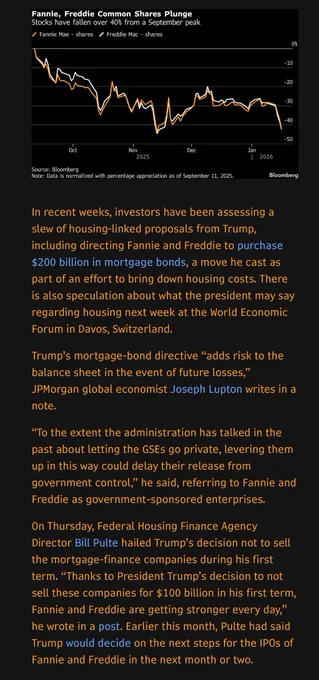
Fannie and Freddie are falling. The 200B MBS buy order does not hurt them. This is exactly what they do- it is their business. It in fact means to do more they need to raise capital, and the way to do that is an IPO.
What I said in my December post below- I think we are in this lull now.
“
Again there are many scenarios here.
So this is neither an automatic nor a necessarily quick win for long-suffering common and junior preferred stockholders.
If the companies do not go public, they will continue to build their respective capital reserves and shrink ERCF funding shortfalls. This means there is not a lot of financial pressure from within the GSEs themselves to move the IPO up on the President’s agenda. They become better capitalized the longer the IPO is put off.
True investors can take heart that further delays alone do not destroy value, as both are now growing book value by double digits. Sentiment will likely drive the securities down significantly if the next year is unproductive on the IPO front, but that could be an opportunity for long-term investors.”
$FNMA$FMCC
Just your daily reminder that stocks are expensive.
To put it in the context of my recent “Fee Fi FOUR Umm…” post, specifically the expected return discussion surrounding FISV, the difference between a 20% expected annualized long-term return on a common stock and an 10% one is logarithmic. The 20% return price can be 4x times the 10% expected return price and 8x the 8% expected return.
This also explains why value investors look like idiots for extended periods. When a stock trading at the 8% expected return price ($160) falls to the 10% return price ($93), it's down 42% and everyone assumes something is broken. To get to the 15% price ($38), it needs to fall 76% from that $160 level. At that point, the business is being treated as terminal. The 20% price is just where everyone wants to give up and go home. And we only see that in any widespread fashion when everyone is indeed giving up and going home - like the 2008-2009 bottom and the second half of 2002. 2020 early in COVID got close but not like that. It’s been a long, long time since it got like that.
Value investors have looked like idiots for a long, long time. Adjust the PE correctly for SBC, Depreciation, Amortization, Fixed/Capital Leases, etc, and it gets worse.
$FISV
DB downgrades FOUR because it sees organic growth falling to the mid teens? Boy do I have a story for you.
$FOUR
What this post says is that if you do not know your history, you cannot see that compute will ultimately accrue to the customer, not to bare metal suppliers of compute. $MSFT and $AAPL seem to know this. $META seemed to, but now commits to dominating bare metal compute. Mistake.
$MSFT$AAPL$META
And Meta gives in, throwing away its one saving grace. Watch ROIC crash. https://t.co/iIZoYujqYC
↗ Quoting @DeItaone
$META
Short Thoughts, new today.
I cover Medicaid fraud/Molina, Shift4, Fannie Mae, the job market and “AI,” etc.
On that last point, during COVID, Medicaid redetermination – that is, re-confirming participant qualifications to be part of Medicaid – were suspended – and this continued for over 3 years!
About 25% of Molina’s membership is in California, where Medicaid enrollment is 10x bigger than Minnesota.
$MOH$FOUR$FNMA
 @michaeljburry
Feb 14, 2026 · 23:24 ET
stock
@michaeljburry
Feb 14, 2026 · 23:24 ET
stock